Five apps that cover the AI photo-scanning use case — honestly assessed, including where each one beats us. Updated September 6, 2026 · Comparison sources: August 2026
The comparison
BodyDex
vs
Other options
Features Pricing Trade-offs
Find the fit for how you track.
The short answer
Choose your Cal AI alternative around what you need beyond a photo scan.
BodyDex: nutrition + protocols
Compare coaching, price and free tiers
More context +
For people who want food and protocol tracking together, one Cal AI alternative is BodyDex — the same multi-item AI photo scanning, plus a free tier, free macros, a full manual database, protocol tracking, and on-device data. MacroFactor is the pick if algorithmic macro coaching is your priority; Yazio (~$47.90/yr) is the budget pick and adds fasting plans; Lose It! is the veteran with a huge claimed database; MyFitnessPal wins on database breadth.
1. BodyDex — AI scanning plus everything Cal AI leaves out
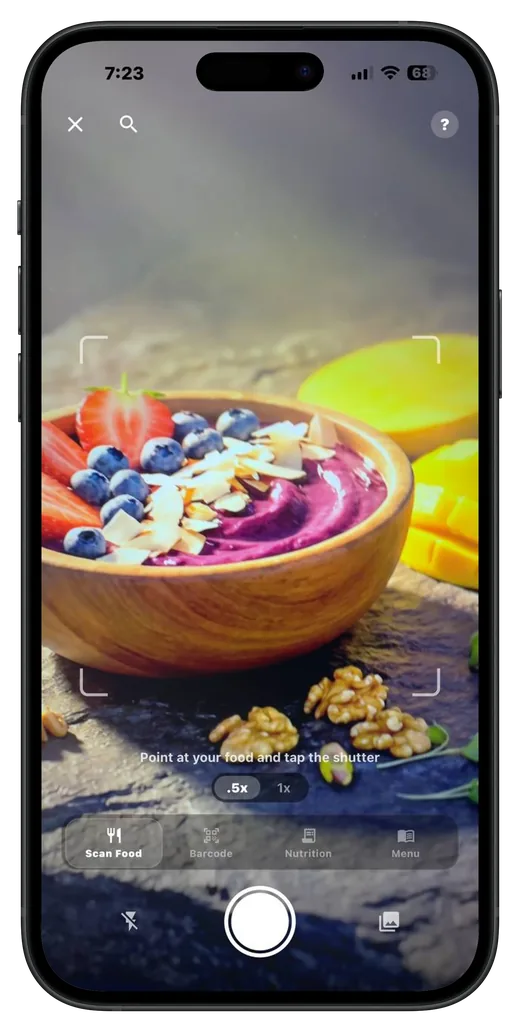
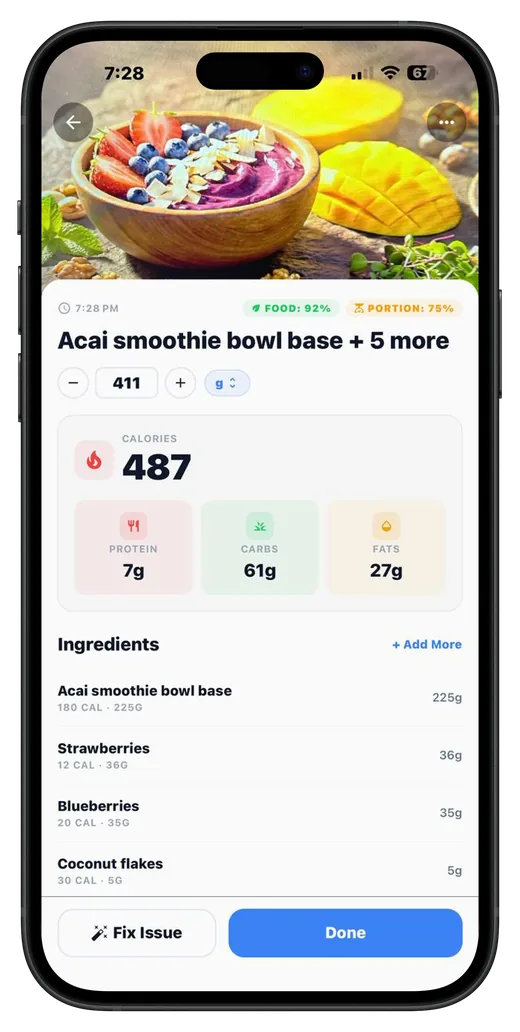
Best overall Cal AI alternative. BodyDex does what Cal AI does — multi-item AI photo scanning with per-item correction — and pairs it with the depth Cal AI skips: a full FatSecret + USDA + Open Food Facts manual log, free custom macros, barcode scanning, recipes, a workout logger, peptide / GLP-1 protocol tracking, and an AI coach grounded in your own data. Data is stored on-device, there are no ads, and unlike Cal AI there's a permanent free tier. Recent additions not listed in Cal AI's official materials: a restaurant menu scanner that reads the printed menu and estimates calories per dish (Premium), a night-shift day window that shows overnight meals in one working-day view (free), and a 24-region muscle heat map tied to the 873-exercise workout library (the heat map and full library are Premium). Premium ($9.99/mo or $79.99/yr, 7-day trial) unlocks AI scanning, voice logging, and the coach.
Pick it if: You want Cal AI's photo-scanning speed but with a real manual log behind it, a usable free tier, and protocol tracking.
2. MacroFactor — the algorithm, with AI scanning added
Best for serious macro coaching. MacroFactor's adaptive expenditure algorithm is genuinely best-in-class for cutting, lean bulking, and recomp — it recalculates your targets weekly from your real data. It added AI photo food logging in April 2025 (Premium-only), so it now covers the scanning use case too. The catch: there's no free tier at all — $11.99/mo or $71.99/yr (~$5.99/mo annual) after the trial; in 2026 the developer also launched a separate MacroFactor Workouts app with a $89.99/yr bundle covering both. If the algorithm is your must-have, it's worth paying for.
Pick it if: You're cutting or lean bulking and want algorithmic weekly macro adjustments more than you want a free tier.
3. MyFitnessPal — the database giant
Best food database, weakest AI value. MyFitnessPal — which acquired Cal AI itself (announced March 2026) — has the largest user-contributed food database in the category; obscure restaurant and regional items are usually already in there. But for the AI-scanning use case specifically, it's the weakest value here: Meal Scan is Premium-gated, and Premium costs $19.99/mo or $79.99/yr (Premium+ $24.99/mo or $99.99/yr), with custom macros and barcode scanning also paywalled. The free tier carries ads.
Pick it if: Database breadth matters more to you than AI scanning quality, or you're already invested in the MFP ecosystem.
4. Lose It! — the veteran with Snap It
Best veteran database after MFP. Lose It! Premium is $79.99/yr for new subscribers — raised from $39.99 in December 2025 (legacy subscribers may keep older pricing) — and includes "Snap It" AI photo logging, which detects the foods in a photo and estimates servings. User reviews commonly report that Snap It identifies the right foods but struggles with portion sizes, so expect to edit. The free tier shows ads, and barcode scanning now requires Premium for new accounts. Its claimed 56-million-item database is a real strength.
Pick it if: You want AI-assisted logging from a long-running veteran with a huge food database and don't mind correcting portion estimates.
5. Yazio — the fasting-friendly budget option
Best for intermittent fasting. Yazio rebranded as an "AI Calorie Tracker" in 2026 and added PRO-only photo-based meal logging. PRO runs about $47.90/yr (frequently discounted) — the lowest listed annual price among the apps compared here, as of August 2026 — and the package includes excellent fasting plans (16:8, 5:2, 6:1) and 3,000+ curated recipes. The free tier includes ads and barcode scanning; AI photo logging requires PRO. Its multi-million-item claimed database has strong European coverage.
Pick it if: You want AI logging plus structured intermittent-fasting plans at a budget price, especially in Europe.
Where Cal AI is still the right call
You want minimal. Cal AI's AI-first, manual-light design is genuinely the simplest workflow here. If you'll never open a food database or track a macro target, the extra depth in these alternatives is overhead, not value.
It already works for you. Switching costs are real. If Cal AI fits your routine and the subscription price you landed on is fair, there's no urgent reason to migrate.
FAQ
Why look for a Cal AI alternative at all?
Three common reasons: Cal AI is subscription-only, with a heavily A/B-tested paywall shown only after the onboarding quiz and a 3-day trial; it's AI-first by design, so manual logging and database search are thin when the photo guess is wrong; and it has no macro coaching, protocol tracking, or workout logging. A newer fourth: MyFitnessPal acquired Cal AI (announced March 2026) — it remains a standalone app (now using MFP's food database), but if you'd rather not be in the MFP ecosystem, that changes the calculus. If any of those matter to you, the alternatives here cover them.
What's the best free Cal AI alternative?
BodyDex has the most usable free tier of the AI-scanning apps in this list: manual logging, barcode scanning, custom macros, recipes, weight, and peptide / protocol tracking are free indefinitely with no ads. AI photo scanning itself is Premium in every app listed here, including BodyDex — no one gives unlimited AI scanning away free as of August 2026.
Is any alternative's AI scanning more accurate than Cal AI's?
We have not published a standardized accuracy comparison of these apps. Photo estimates depend on visible ingredients, preparation and portion size; review the foods and amounts before saving. Compare how easily each app lets you edit portions, add missing ingredients and use food labels or database entries. BodyDex supports those corrections alongside AI scanning.
What's the cheapest Cal AI alternative?
Yazio PRO at roughly $47.90/year (often discounted further) is the lowest listed annual price among the apps compared here, as of August 2026. MacroFactor's annual works out to about $5.99/month ($71.99/yr). BodyDex, MyFitnessPal, and Lose It! are all $79.99/year — Lose It! raised its new-subscriber annual price from $39.99 in December 2025 (legacy subscribers may keep older pricing). On monthly plans, BodyDex is $9.99 versus MyFitnessPal's $19.99.
Which alternative also tracks GLP-1s or peptides?
For peptides and protocols broadly, only BodyDex — weekly GLP-1 dose schedules, BPC-157 cycles, reconstitution math, and supply alerts alongside the food log, stored on-device. One honest update: MyFitnessPal launched a free GLP-1 Support tool in April 2026 (US users) that tracks GLP-1 dose, injection site, side effects, and reminders — but it's GLP-1-only and cloud-based. Cal AI, MacroFactor, Lose It!, and Yazio list no medication tracking in their official materials. If you're tracking a full protocol plus macros, BodyDex is the only single-app option in this list.
Can I switch from Cal AI without losing my data?
Cal AI's export options are limited, so plan on a fresh start in most cases. The good news: you can keep a copy of your old records and start a new log whenever you choose. BodyDex starts you with a quick onboarding that sets calorie and macro targets in about two minutes.
Is MacroFactor or BodyDex the better Cal AI replacement?
Depends on your goal. If you want algorithmic weekly macro coaching and don't mind paying from day one, MacroFactor's adaptive expenditure model is the best in the business. If you want a free tier, multi-item AI scanning, an AI coach you can chat with, protocol tracking, and on-device data, BodyDex covers more ground for less.
Cal AI, MacroFactor, MyFitnessPal, Lose It!, and YAZIO are trademarks of their respective owners. BodyDex is not affiliated with or endorsed by any of them. Pricing and features verified August 2026 from each publisher's public marketing pages and app-store listings — products evolve, so always confirm current details on the publisher's site before deciding. All trademarks are the property of their respective owners.
 BodyDex